Understanding the science, workflow and laboratory considerations behind next-generation sequencing for preimplantation genetic testing for aneuploidy
Introduction: Bringing Genomic Technology Closer to Reproductive Health
Advances in assisted reproductive technology continue to expand the tools available to fertility specialists. Alongside embryology and established IVF procedures, genomic technologies offer ways to investigate the chromosome composition of embryo biopsy samples and provide additional information that may support reproductive decision-making.
One of these technologies is next-generation sequencing (NGS), which enables the analysis of DNA across multiple genomic regions simultaneously. In reproductive genetics, NGS can be used in preimplantation genetic testing for aneuploidy (PGT-A) to assess chromosome copy-number patterns in sampled embryonic cells.
For IVF centres, this presents an opportunity to explore how genomic testing could fit into their existing services and whether developing an in-house testing capability aligns with their scientific, operational and business objectives.
At The GeneLab Lifescience Company Limited, in collaboration with Thermo Fisher Scientific, we support laboratories exploring genomic technologies through product guidance, workflow discussions, training and technical support.
What Is PGT-A and Why Does It Matter?
Human cells typically contain 46 chromosomes arranged in 23 pairs. Aneuploidy refers to an abnormal number of chromosomes, such as an additional or missing chromosome.
PGT-A examines DNA from a biopsy sample, commonly collected from the trophectoderm of a blastocyst, to assess whether the sample shows evidence of chromosome gains or losses.
NGS-based PGT-A evaluates chromosome-wide DNA representation to identify copy-number patterns consistent with aneuploidy. Depending on the validated assay and analysis configuration, results may also provide information about certain segmental copy-number changes and patterns suggestive of mosaicism.
PGT-A results can contribute to embryo assessment, but they are only one part of reproductive decision-making. They do not guarantee implantation, pregnancy or a live birth, and findings must be interpreted by appropriately qualified professionals in the context of the test’s limitations and the patient’s clinical circumstances.
It is also important to distinguish PGT-A from other forms of preimplantation genetic testing. PGT-M targets specific monogenic conditions, while PGT-SR addresses structural chromosomal rearrangements.
Understanding the Ion ReproSeq™ PGT-A Workflow
Thermo Fisher Scientific’s Ion ReproSeq™ PGS workflow brings together compatible Ion Torrent™ sequencing technology and dedicated software for PGT-A research applications.
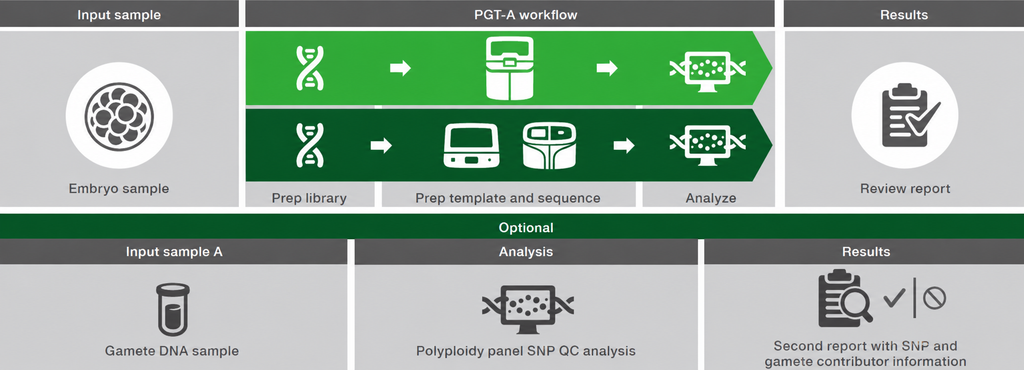
A typical workflow involves several connected stages, each contributing to the quality of the final data.
1. Embryo biopsy and sample preparation
A qualified embryologist collects an appropriate biopsy sample according to the laboratory’s procedures. Because the sample contains a limited number of cells, careful handling, accurate identification and traceability are essential.
The quality of the starting material can influence downstream processing and analysis.
2. Whole-genome amplification and library preparation
The DNA obtained from a small biopsy sample is amplified through whole-genome amplification (WGA) to generate sufficient material for subsequent analysis.
The amplified DNA is then prepared for sequencing through library preparation, which introduces the necessary components for processing on the compatible NGS platform.
3. Automated template preparation with the Ion Chef™ System
The Ion Chef™ System automates key template-preparation steps for compatible Ion Torrent workflows. Automation can help standardise repeatable laboratory processes and reduce manual intervention. It also provides a structured workflow for preparing sequencing material, although correct setup, appropriate consumables and adherence to the applicable protocol remain essential.
4. Sequencing with the Ion GeneStudio™ S5 System
The Ion GeneStudio™ S5 System generates sequencing data for downstream analysis.
For PGT-A, the objective is to evaluate chromosome-level copy-number patterns rather than simply identify a single genetic variant. The resulting data provide the basis for assessing evidence consistent with chromosome gains or losses in the tested sample.
The system supports different sequencing configurations, allowing laboratories to evaluate options according to their intended workflow and anticipated sample throughput.
5. Data processing and analysis
Once sequencing is complete, the data move into the software component of the workflow.
Torrent Suite™ Software supports sequencing data processing and the relevant run workflow.
Ion Reporter™ Software supports compatible downstream genomic analysis, including the applicable PGT-A research workflow.
Analysis focuses on chromosome copy-number patterns and associated quality information. Proper sample identification, workflow configuration, quality assessment and competent review are important for interpreting the results appropriately.
The workflow therefore combines laboratory procedures, instrument automation, sequencing and bioinformatics. Understanding how these components work together is essential when planning an NGS-based PGT-A capability.
What Can an Integrated NGS Workflow Offer an IVF Laboratory?
A connected workflow from sample to data
The Ion ReproSeq™ workflow combines multiple stages of genomic analysis within a defined process. Providing instruments and software that help laboratories coordinate sample processing, sequencing and data analysis rather than treating each stage as an isolated activity.
Automation of key processing steps
The Ion Chef™ System automates key stages of template preparation. For laboratories, this can help standardise routine processes and reduce the amount of manual handling required at those stages.
Automation does not remove the need for trained personnel, quality controls or appropriate oversight, but it can support a more structured workflow.
Configuration options to match testing needs
Laboratories differ in their expected testing volumes, staffing arrangements and growth plans. The appropriate system configuration should reflect the number of samples anticipated, how frequently testing will be performed and the overall cost of generating a reportable result.
Selecting a configuration that fits the laboratory’s needs is more useful than simply choosing the highest available throughput.
Integration of laboratory work and bioinformatics
NGS involves more than generating sequencing data. The analysis stage is essential to evaluating chromosome copy-number patterns and understanding the quality and limitations of the findings.
The combination of sequencing instruments and dedicated analysis software provides a framework for connecting laboratory processing with genomic data interpretation.
What Should Your Facility Consider Before Setting Up a PGT-A Laboratory?
Establishing an in-house PGT-A laboratory can be a practical step towards expanding an IVF centre’s reproductive genetics capabilities. With the right equipment, workflow and technical support, a facility can explore developing its own NGS-based testing capability.
Several key considerations include:
Laboratory space and equipment: A suitable workspace and the right combination of instruments and supporting equipment are important. The proposed setup can be planned around the facility’s needs and intended testing capacity.
Training and staffing flexibility: An existing embryologist or a designated laboratory staff member can be trained to manage the routine workflow. With appropriate training and competency assessment, one trained staff member may carry out routine processing, subject to the laboratory’s quality procedures, staffing arrangements and operational requirements.
Training and ongoing technical support: Familiarity with instrument operation, sample preparation, run setup and data analysis helps staff understand the complete workflow. The GeneLab Lifescience can support discussions around training and technical requirements in collaboration with Thermo Fisher Scientific, according to the agreed scope of support.
A solution that fits your centre: The proposed laboratory setup can be tailored to expected sample volumes, existing infrastructure, available resources and future plans.
An important first step is to discuss the laboratory’s goals and assess which configuration and implementation approach are most appropriate.
Beyond the Instruments: The Role of The GeneLab Lifescience
Technology is only one component of establishing a successful laboratory workflow. Understanding product requirements, selecting a suitable configuration, training personnel and planning ongoing technical support are also important.
As an authorised Thermo Fisher Scientific channel partner, The GeneLab Lifescience Company Limited works with customers to explore relevant life science and laboratory solutions.
For IVF centres considering NGS-based PGT-A, our role includes helping laboratories understand the available workflow options, discussing equipment and implementation requirements, coordinating technical engagement and supporting installation and training activities as appropriate.
Every facility has different needs. Some may already have molecular laboratory infrastructure, while others may be exploring NGS for the first time. A productive discussion starts with understanding those differences and identifying a suitable path forward.
Is Your IVF Centre Ready to Explore In-House PGT-A?
Developing an in-house PGT-A capability does not have to begin with an immediate equipment purchase. It can start with a conversation about testing demand, a review of existing laboratory facilities, a discussion about staffing and training, or an assessment of the available workflow configurations.
With the right planning, IVF centres can better understand the scientific, operational and financial considerations involved in bringing genomic technology into their laboratory.
The GeneLab Lifescience is ready to help your facility explore the possibilities.